
🇦🇺 Trending in Australia
Why Your Snoring & Sleep Apnea Keep Getting Worse: Every Treatment You've Tried Misses the Real Cause
I'm sharing this because, in 22 years of treating sleep disorders, I haven't seen a bigger breakthrough than this one, and you deserve to hear about it.
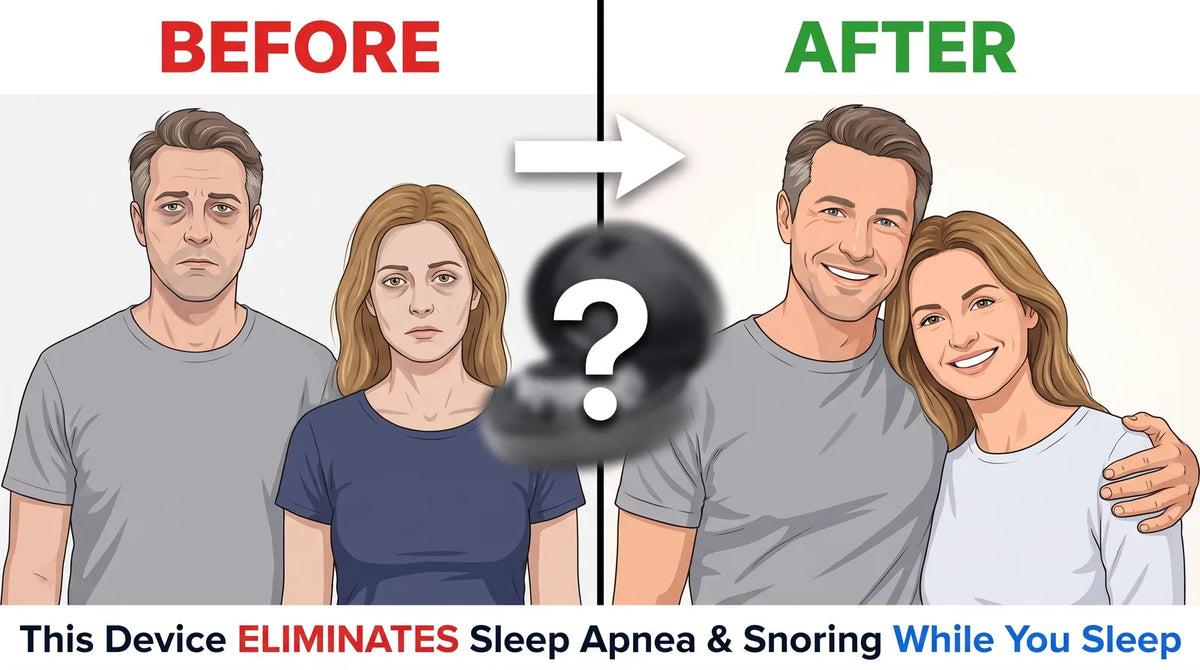
Please read this slowly. Every word of it.
Not because I want to sell you anything. Because what follows could genuinely change the direction of your health, and it may even save your life. That's not something I say casually.
I've treated sleep apnea and snoring for more than twenty years. Thousands of patients have sat in my clinic. So I can tell you now: I already know your story. I've heard it a thousand times over.
You're worn out. Not normal tired. The deep, in-your-bones exhaustion where 8 hours in bed feels like 2.
Your partner doesn't complain about your snoring any more. Not because it stopped, but because they've given up. Perhaps they sleep in the spare room now. Perhaps the resentment is quietly building. Perhaps you're scared your relationship won't make it through this.
Your mind isn't as sharp as it was. The fog. The forgetting. Drifting off mid-meeting, losing the thread of an easy conversation. You used to be quick. Now you wonder where that person went.
Then there are the nights. The gasping. Jolting awake at 3am with your heart racing, as if someone had pressed a pillow over your face. That frightening sense that your body simply... forgot to breathe.
I know. I've heard every version of it. And there's something vital I need you to grasp:
This won't fix itself. It will get worse. And it is far more dangerous than you realise.
Why I'm Begging You to Take This Seriously
I rarely write pieces like this. But I worry about the people my clinic never reaches.
Here's what most people never realise about snoring and sleep apnea:
It isn't a noise problem. It's a suffocation problem.
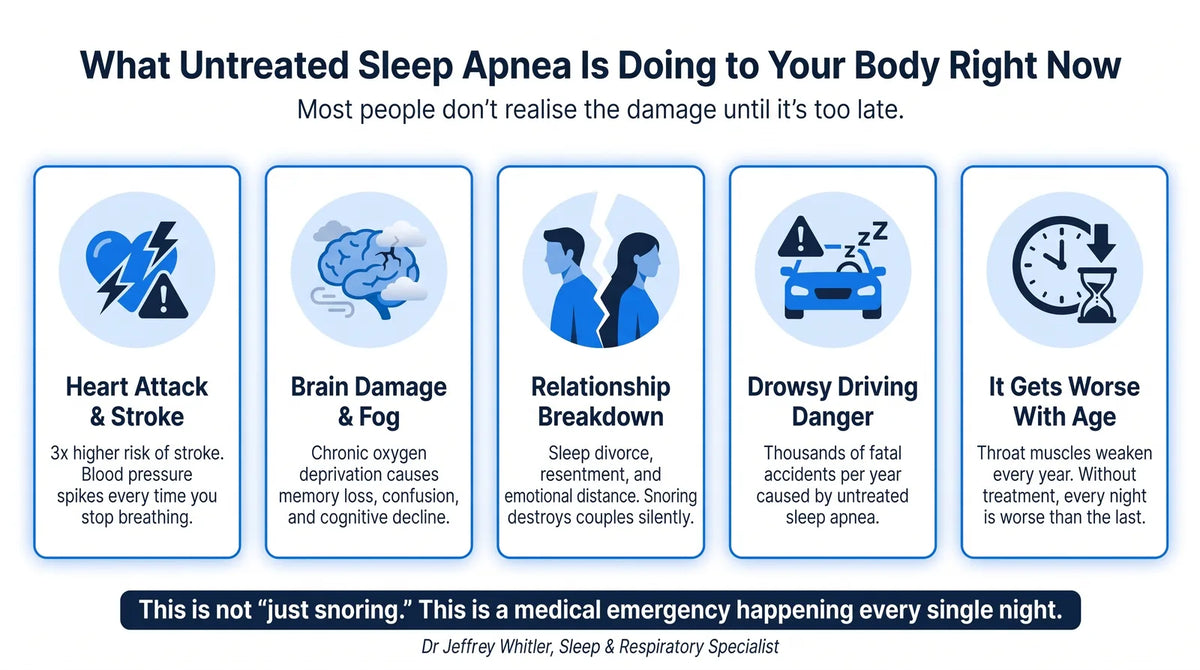
Each snore means your airway is partly blocked. Each time you stop breathing in your sleep (and if you snore heavily, you almost certainly do), your brain goes short of oxygen. Not once or twice. Dozens of times an hour.
None of this is theory. It's what happens inside you every single night:
→ Your blood pressure surges with each pause in breathing. Night after night, year after year, it quietly wears down your heart and blood vessels.
→ Your heart is pushed into overtime to make up for the falling oxygen. People with untreated apnea face a 3x higher risk of stroke and a much higher risk of heart failure.
→ Your brain takes damage. The fog, the memory lapses, the short fuse: that isn't ageing. It's long-term oxygen starvation, and it doesn't undo itself.
→ Your relationships wear thin. I've seen marriages end over snoring. Not for lack of love, but because years of broken sleep breed a resentment that even love struggles to outlast.
→ Your safety is at risk. Drowsy driving caused by untreated apnea kills thousands of people every year. Some of my own patients have nearly nodded off at the wheel.
I'm not telling you this to frighten you. I'm telling you because too many of my patients waited. They told themselves it was "only snoring". By the time they took it seriously, the harm to their hearts, their minds and their relationships had already been done.
Please don't become one of them.
What Happens If You Keep Putting This Off
I went back and forth on including this part. It's uncomfortable to read. But too many patients have sat across from me saying "I wish someone had warned me sooner", so I'm warning you now.
Here is what untreated snoring and sleep apnea do to your body over the years. It isn't guesswork. It's what I've seen in my own practice, backed by decades of clinical research.
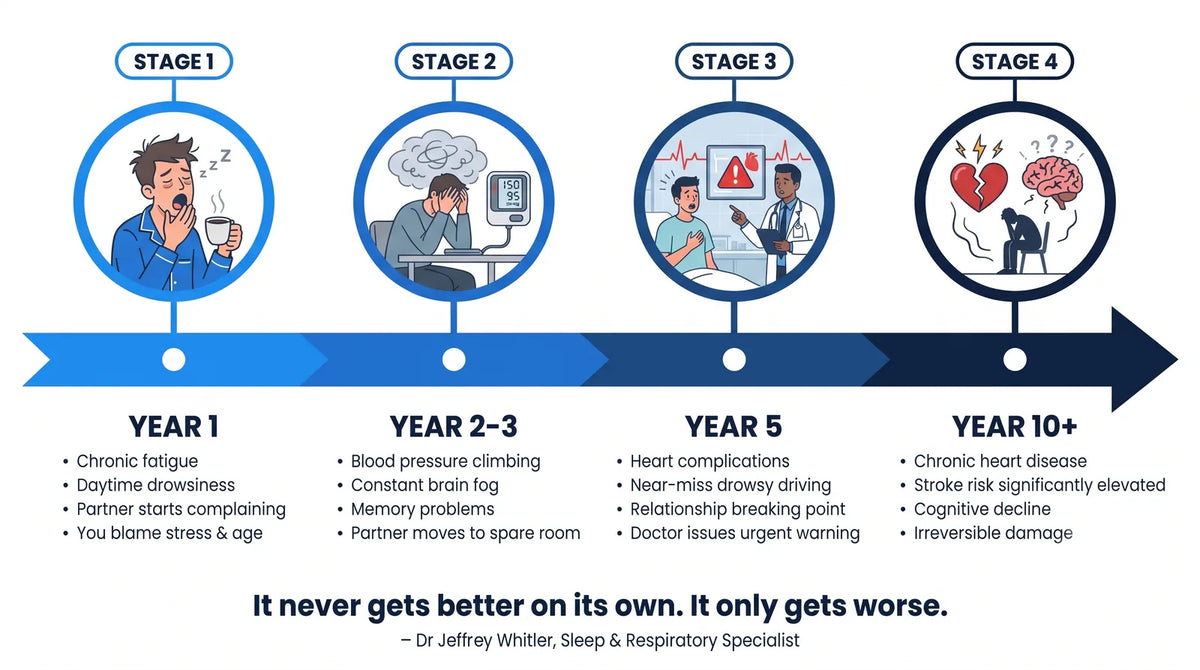
-> Year 1: The "It's Only Snoring" Stage
You shrug it off. Your partner grumbles, you try a few nasal strips, nothing changes. Meanwhile your blood oxygen dips every night. You're always tired, but you put it down to stress, work or age. You're not quite the person you were, but the slide is so slow you don't see it.
-> Years 2 to 3: The Damage Speeds Up
Your blood pressure begins to creep up. Your doctor prescribes medication but can't work out why it won't settle. The brain fog is now constant: you forget things, can't focus, feel flat. Your partner has moved into the spare room. Neither of you mentions it any more. The resentment is quiet, but it's growing.
-> Year 5: The Wake-Up Call
A health scare. An irregular heart reading. A near miss after nodding off at the wheel. Or worse, your partner tells you they can't keep doing this. That's usually when my patients finally come to see me. Five years too late. Five years of damage that never had to happen.
-> Year 10+: The Point of No Return
Chronic heart disease. A raised risk of stroke. Cognitive decline that looks like early dementia. Relationships that couldn't be rescued. I treat people at this stage. Good people who simply had no idea what their snoring was doing to them.
I'm not writing this to scare you. I'm writing it because I'm tired of meeting patients at Year 5 when I could have helped them at Year 1.
Right now you're at Year 1. Possibly Year 2. If you're reading this, you still have time.
Please don't let it slip away.
So What's Really Behind It?
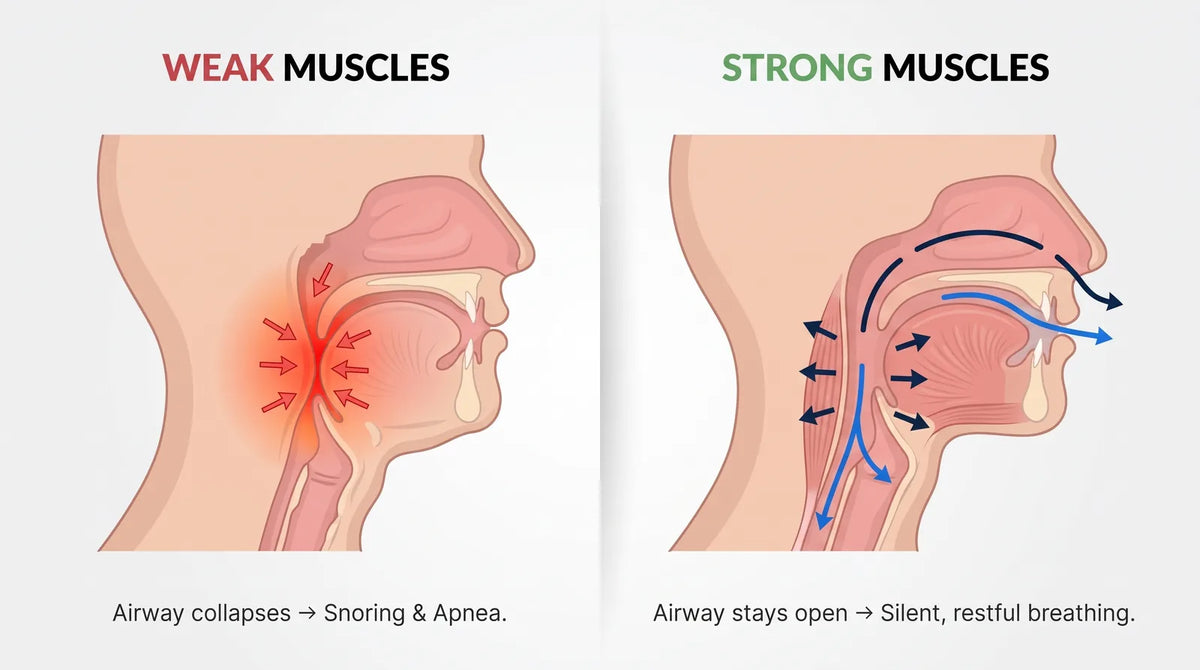
This is what I explain to every new patient at their first appointment:
Your snoring and sleep apnea don't start in your nose. They don't come from the way you sleep. They aren't even caused by your weight, although extra weight can make them worse.
They start with the muscles in your throat.
As you fall asleep, those muscles relax. In some people, and more so as we get older, they relax so far that they sag inwards, narrowing your airway or closing it off completely.
Narrowed airway = snoring.
Closed airway = sleep apnea.
That's all there is to it. That's the whole mechanism.
And it's exactly why nothing you've tried so far has worked.
Why Nasal Strips, CPAP and Mouthguards All Let You Down
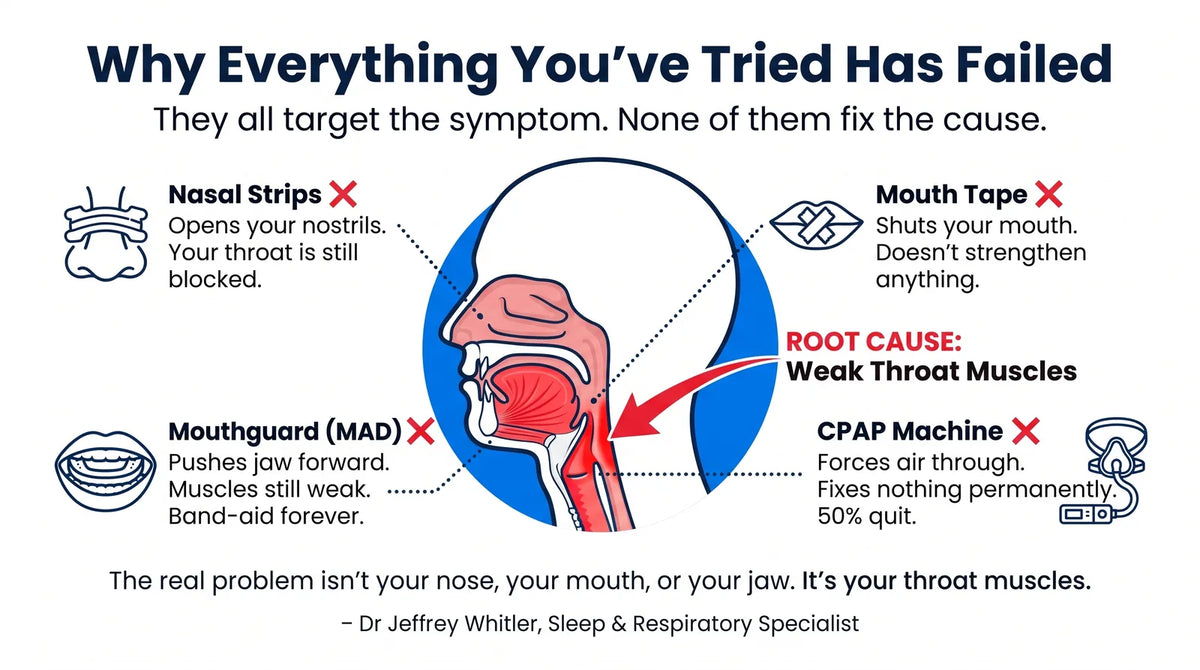
Nasal strips, mouth tape, special pillows: none of them reach your throat muscles. It's like putting a plaster on a broken bone.
CPAP machines force your airway open with pressurised air. They do technically work. But 50% of patients give up within months because of the claustrophobia, the noise, the discomfort and the $1,500+ price. In my clinic I call CPAP a "medical shackle". It holds back the symptom every night and fixes nothing for good.
Mouthguards (MADs) push your jaw forward to open the airway. But with custom ones costing $2,000, plus jaw pain, shifting teeth and a lifetime of relying on something in your mouth, they're a stopgap, not a cure.
Every one of these treats the symptom. Not one of them strengthens the muscles behind the problem.
Until now.
The Breakthrough I Wish I'd Found 10 Years Earlier
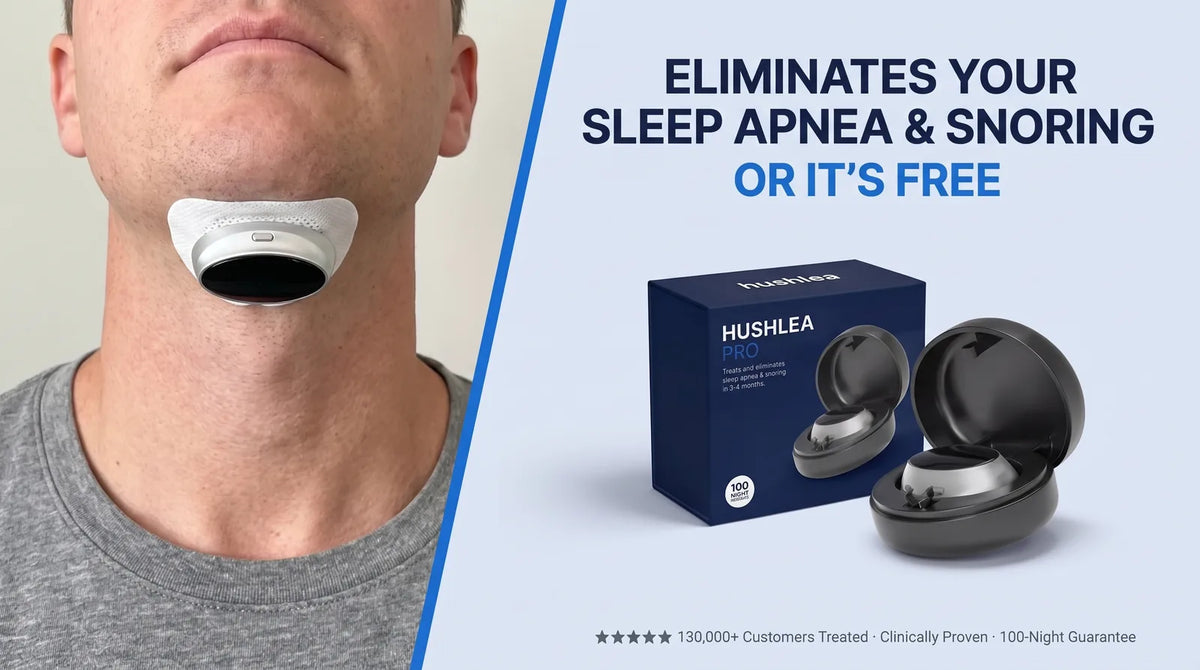
I'll be straight with you: when I first heard about Hushlea Pro, I was sceptical. Another gadget? Another big promise?
Then I went through the clinical data. Then I suggested it to a handful of patients who had failed every other treatment. Then I watched their numbers move.
✓ AHI scores falling.
✓ Oxygen levels steadying.
✓ Partners ringing my clinic to say thank you.
I've now personally recommended Hushlea Pro to more than 400 of my patients. It's the only option I've found that goes after the real root cause, weak throat muscles, rather than covering it up.
This is how it works:
Hushlea Pro is a small, featherlight device that sits under your chin as you sleep. You can't feel it. You can't hear it.
It uses clinically proven NEMS technology (Neuromuscular Electrical Stimulation) to send gentle micro-pulses to your throat muscles all night long. Those pulses tone and strengthen the muscles, so your airway stays open naturally.
No mask. No hose. No mouthpiece. No surgery. Nothing in your mouth or over your face.
Switch it on. Go to sleep. It does the rest.
But this is what truly sets it apart from everything else:
You won't need it forever.
After 100 days of regular use, 95% of patients find they no longer need the device. Their throat muscles have been retrained to stay firm by themselves. The snoring ends. The apnea resolves. For good.
This isn't managing a symptom. It's a protocol built to cure it.
More than 130,000 people have already completed it.
Let Me Be Blunt
Across 22 years of practice, I've watched patients go round the same loop:
Ignore the snoring → try nasal strips → fail → try CPAP → hate it → give up → try a mouthguard → give up again → resign themselves to being exhausted for life.
All the while their blood pressure rises, their relationships crack, their careers suffer and their risk of heart attack and stroke edges up every single year.
I'm tired of watching it.
Hushlea Pro is the only solution I've come across that breaks the loop, because it's the only one that repairs what's actually broken: the muscles in your throat.
It's non-invasive. It's comfortable. It works while you sleep. And after 100 days, most patients are finished with it. Their airway stays open by itself. No more devices, machines or mouthpieces. Ever again.
I can't make you act. But as a doctor who has seen what happens when people wait, when they tell themselves "it's only snoring" for one more year, then two, then five, I'm asking you:
Don't wait.
Your heart can't wait. Your brain can't wait. Your partner can't wait. And every untreated night leaves your body weaker, not stronger.
If you saw yourself in anything I've written here, please take the next step. Not tomorrow. Tonight.
This is the answer. I've put my professional reputation behind it. And it comes with a 100-night money-back promise, so you have absolutely nothing to lose.
You Risk Nothing. I Made Sure of It.
Before I recommend anything to a patient, I need to know they're protected. I don't bend on that.
That's why I asked the Hushlea team about their guarantee before I wrote a single word about them. Their answer is the reason I'm happy to put my name to this.
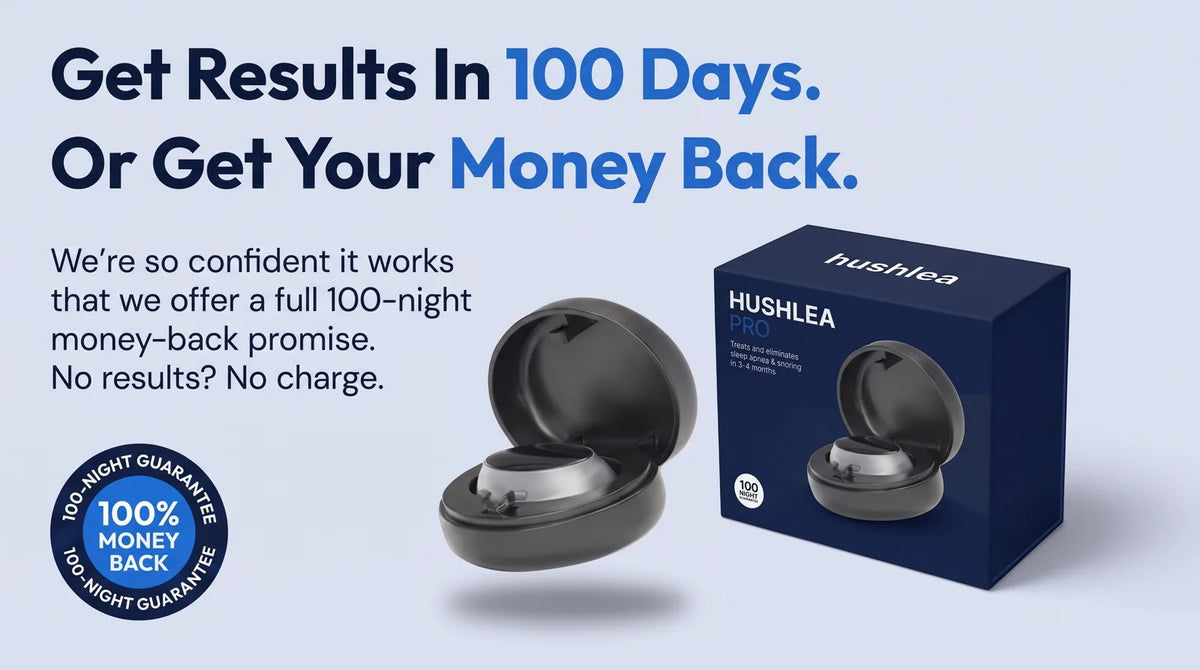
You get 100 full nights to try it.
Not 30. Not 60. A hundred nights, because genuine muscle retraining takes time, and they want you to go through the full protocol before you decide.
If after 100 nights your snoring or sleep apnea hasn't stopped... if your partner isn't sleeping better... if you don't wake up feeling like a new person...
Just email them. Full refund. No interrogation. No hoops. No "restocking fee". You don't even need to send the device back. They only ask that you give it a fair trial first: at least 45 nights of use, so your muscles have time to respond.
In 22 years of practice, I've never seen a company back a medical device like this. They can afford to because it works, and they know it.
So let me be clear: the only real risk is doing nothing.
A Personal Note About the Person Beside You
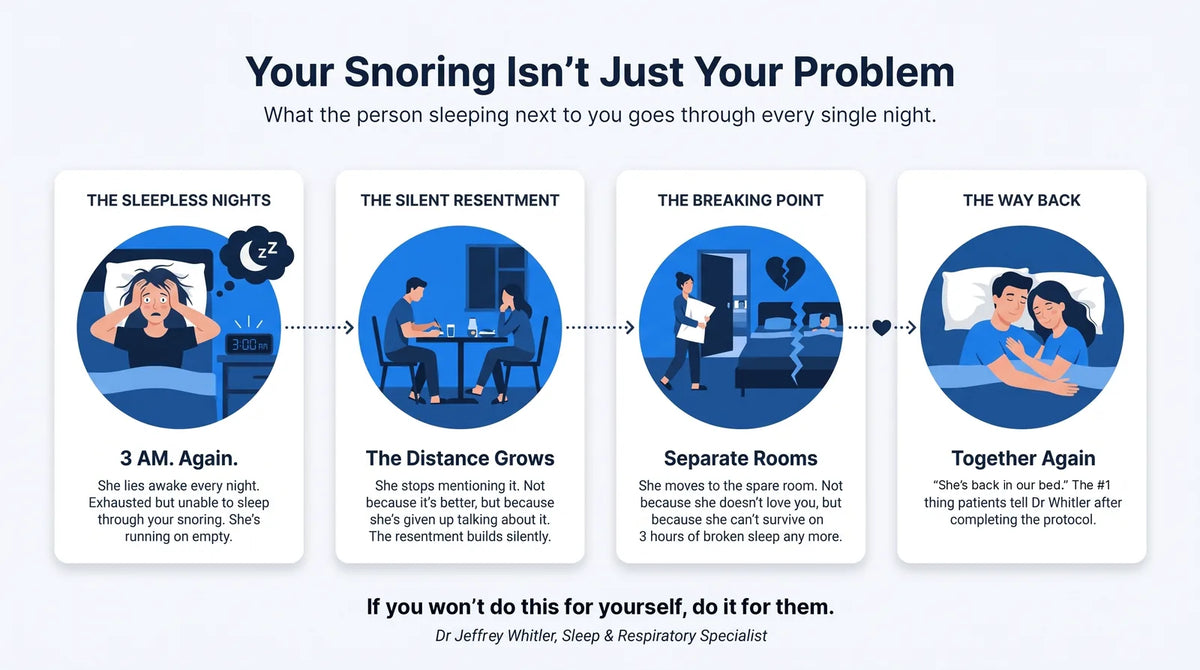
There's something I want to talk about that medical articles rarely mention.
Your partner.
In my clinic, I don't only treat the patient. I treat the couple. Snoring and sleep apnea are never a one-person condition. They wreck two people's sleep, two people's health and two people's patience.
I've had wives sit in my office in tears. Not angry, just exhausted. Years of broken nights. Years of lying awake listening to someone they love fight for air at 3am, wondering whether tonight is the night the breathing doesn't start again.
I've had husbands tell me they feel like failures, ashamed of a noise they can't control, watching their marriage wear away one sleepless night at a time.
This is what I need you to understand:
Fixing your snoring isn't only about you. It's about the person lying awake next to you every night. The person who moved to another room, not because they stopped loving you, but because they physically can't keep going on 3 hours of broken sleep.
When my patients finish the Hushlea protocol, the first thing most of them say isn't "I'm sleeping better".
It's "She's back in our bed."
It's "He finally looks rested in the morning."
It's "We feel like a couple again."
If you won't do it for yourself, do it for them. They've waited long enough.
How Does It Work? (It Takes 30 Seconds)
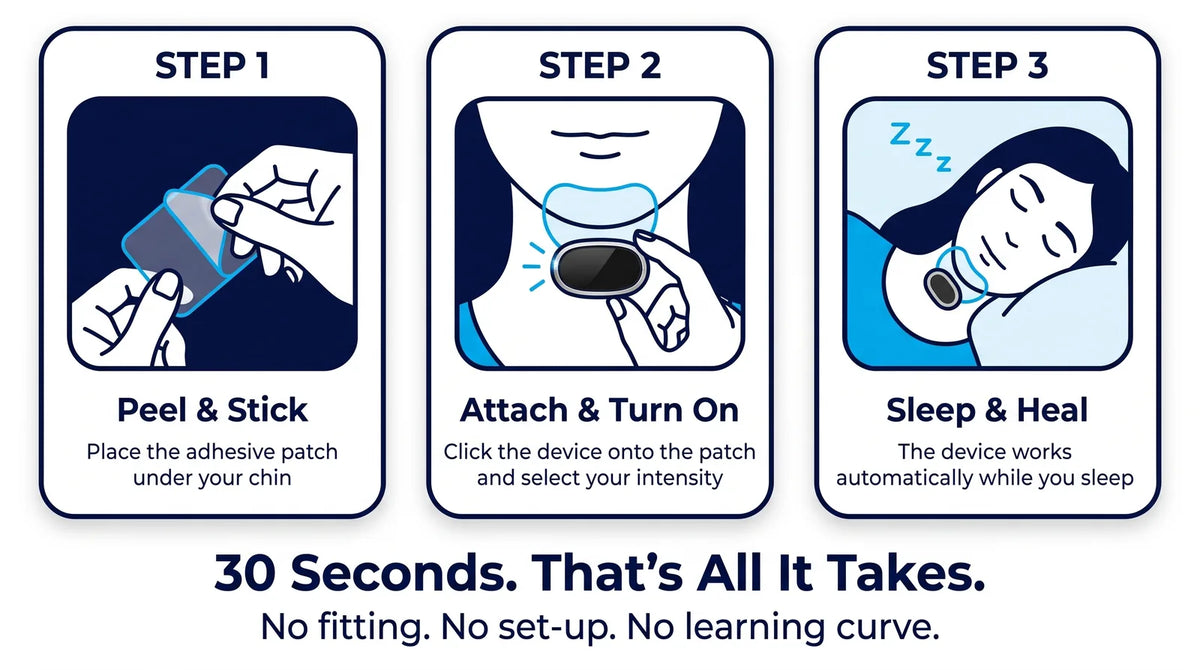
My patients love how ridiculously simple Hushlea Pro is. No set-up. No fitting appointment. Nothing to learn.
Step 1: Peel the backing off the adhesive patch and press it under your chin. Five seconds.
Step 2: Fix the device onto the patch. It clicks into place.
Step 3: Press the button, pick your intensity (there are 3 levels) and go to sleep.
That's all.
The device runs on its own through the night, sending gentle micro-pulses to your throat muscles to keep them toned and your airway open.
You can't feel it. You can't hear it. Most of my patients forget they're wearing it within two minutes.
And here's the bit that still surprises me as a doctor:
After 100 days of regular use, the great majority of patients find their throat muscles have been retrained. They hold firm by themselves. The snoring stops. The apnea resolves.
You take it off, and the results stay.
No other option on the market can claim that. Not CPAP. Not mouthguards. Not surgery. Only Hushlea Pro treats the cause rather than managing the symptom.
What to Expect Over Your First 100 Days
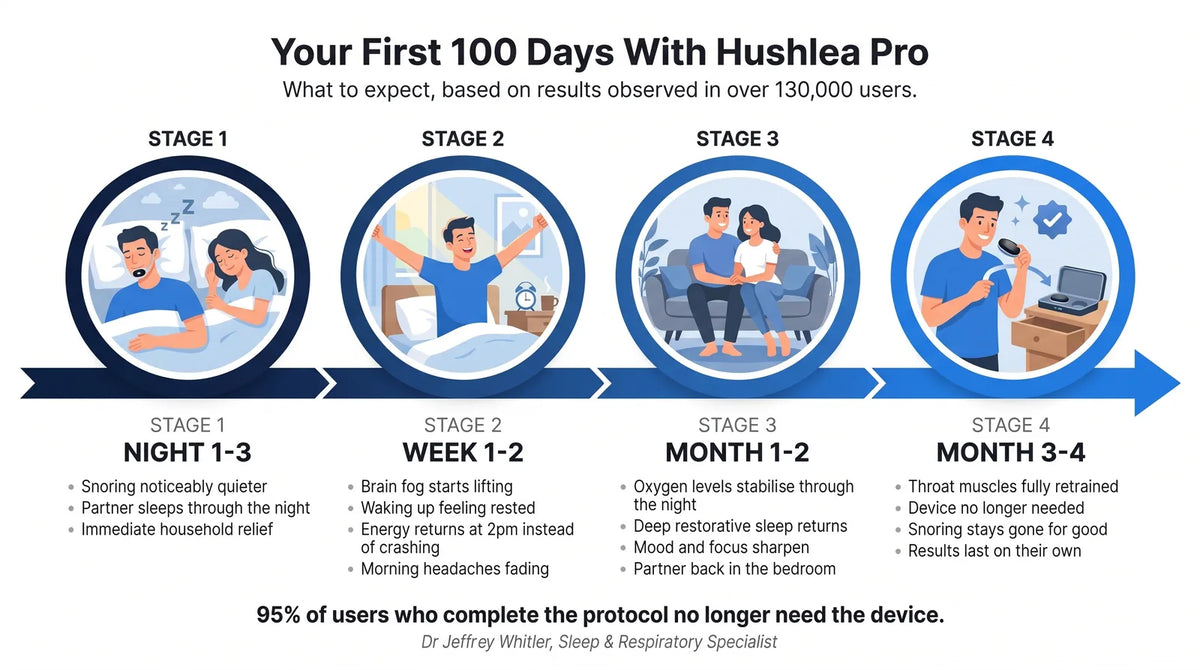
Patients always ask me, "How quickly will it work?" This is what I tell them, based on what I've seen across hundreds of cases.
-> NIGHTS 1 TO 3: Instant Relief
Your partner notices first. The snoring is softer, and sometimes gone completely from the very first night. You may not feel very different yet, but the person beside you sleeps right through for the first time in months. That alone changes the mood in your home.
-> WEEKS 1 TO 2: The Fog Begins to Clear
This is when YOU start to notice. You wake up and something feels... different. The heaviness has gone. Your head is clearer. You've got energy at 2pm instead of hitting a wall. The headaches ease off. It's subtle at first, then one morning you realise you feel like yourself again. Patients tell me this is when they know it's working.
-> MONTHS 1 TO 2: The Turnaround
Your oxygen levels hold steady through the night. Your body begins recovering from years of deprivation. The deep, restoring sleep you haven't had in years comes back. Your mood lifts. Your focus sharpens. Your partner stops sleeping in the other room. This is where the relationship starts to heal, and it happens sooner than you'd think.
-> MONTHS 3 TO 4: The Lasting Change
Your throat muscles are now retrained. They stay firm without help. You start forgetting to put the device on, then realise you don't need it any more. The snoring stays gone. The apnea events stay at zero.
This is when my patients look at me and ask, "Why didn't I do this years ago?"
95% of users who finish the 100-day protocol no longer need the device. Their muscles remember. The results last.
The Questions My Patients Ask Me Every Day
Having recommended Hushlea Pro to more than 400 patients, I hear the same questions again and again. Here are my honest answers.
Will it hurt? Can I feel the pulses?
No. The micro-stimulation is so gentle that most patients forget the device is on within two minutes of lying down. I've had patients with extreme sensitivity try it, and none reported any discomfort. It's nothing like a TENS machine. Think of a faint hum, well below your pain threshold.
My sleep apnea is severe (AHI 50+). Will this really work for me?
Yes. Some of the most dramatic results I've seen have actually come from severe cases.
One patient of mine went from an AHI of 68 to under 5 in three months. Severe cases often respond strongly to NEMS therapy because the muscle weakness is so marked, so there's more room to improve.
That said, if your apnea is severe, don't stop any current treatment suddenly. Use Hushlea Pro alongside what you already use, then taper off as your numbers improve.
What if I move around a lot in my sleep?
The device stays put. The medical-grade adhesive patch is made to hold through 8+ hours of movement. I've had patients who sleep on their front, on their side, or toss and turn all night, and it holds.
Even if it shifts a little, the NEMS technology keeps working as long as it's roughly in the chin area.
Is it really permanent, or will I need it again?
From what I've observed clinically, 95% of patients who complete the full 100-day protocol keep their results long term.
Your throat muscles build real tone, the same way any muscle does with regular training. Some patients wear the device now and then as "maintenance", perhaps once a month, but the vast majority are completely device-free after the protocol.
I've tried absolutely everything. Why would this be any different?
Because everything you've tried deals with the symptom: the noise, the blocked airway, the position of your jaw.
None of it strengthens the muscles causing the problem.
Hushlea Pro is the only solution that targets the root cause: weak throat muscles. It doesn't manage your apnea. It retrains your body to resolve it.
Why hasn't my doctor told me about this?
NEMS technology for sleep apnea is fairly new compared with CPAP, which has been the standard for decades.
Medicine is slow to adopt new things. CPAP itself took 15 years to go mainstream.
Plenty of sleep specialists now know about neuromuscular stimulation therapy, but referral pathways haven't caught up yet. That's exactly why I'm writing this article: to close that gap.
What if it doesn't work for me?
Then email within 100 nights and you get a full refund. They only ask that you use it for at least 45 nights first, so your muscles have a fair chance to respond.
I wouldn't recommend a product that didn't protect you like this.
The only thing it costs you is the time to try it, and given what's at stake, I'd say that's the best investment you'll make.
Dr Jeffrey Whitler has practised as a sleep and respiratory specialist for 22 years and has treated more than 8,000 patients with sleep-disordered breathing. He has no financial relationship with Hushlea and is not paid for this article. He recommends Hushlea Pro purely on the clinical results he has seen in his own patients.